
Industries · Education & non-profits
Websites and apps for schools, madaaris and religious organisations
Whoever runs the office week to week, a secretary or a masjid's rep, must be able to post the update without phoning a developer.
01Proof
Already live
Sites and systems we run for businesses in this sector.
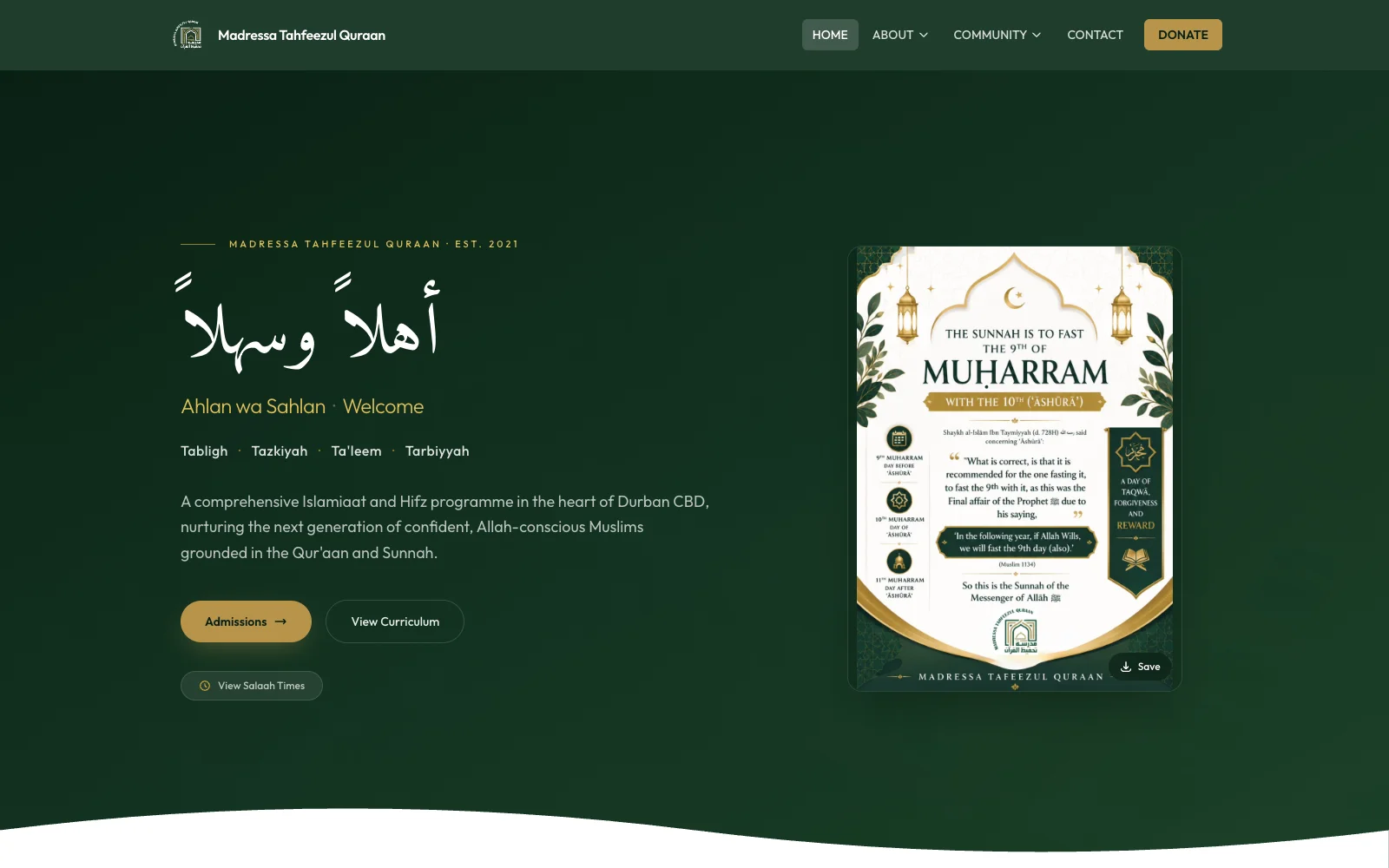
tahfeezulquraan.co.za
Tahfeezul Quraan
Durban CBD madressa: Islamiaat and Hifz programmes, with admissions online and daily salaah times.
Live site
Site for a Durban CBD madressa with its Islamiaat and Hifz programmes, admissions online and daily salaah times.
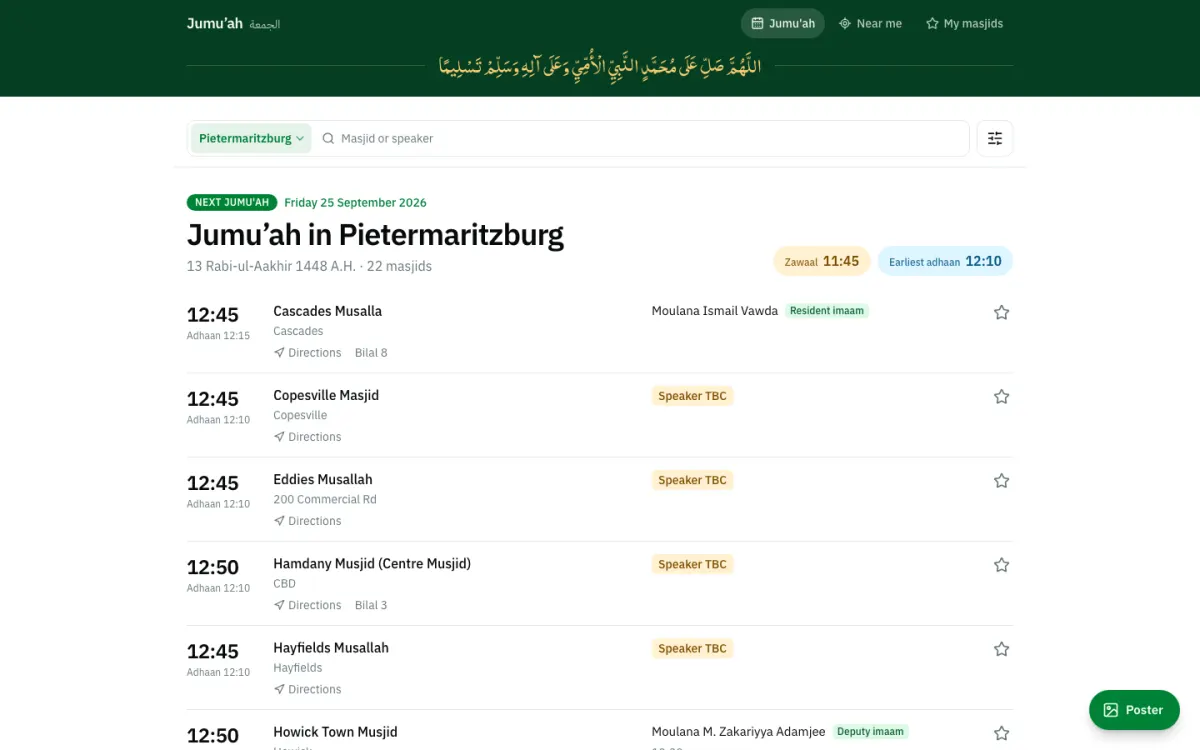
jumuah.co.za
Jumu'ah
Weekly Jumu'ah times and speakers for 22 masjids, updated by each masjid's own rep.
Live site
Weekly Jumu'ah times and speakers for 22 masjids, each updated by the masjid's own rep.
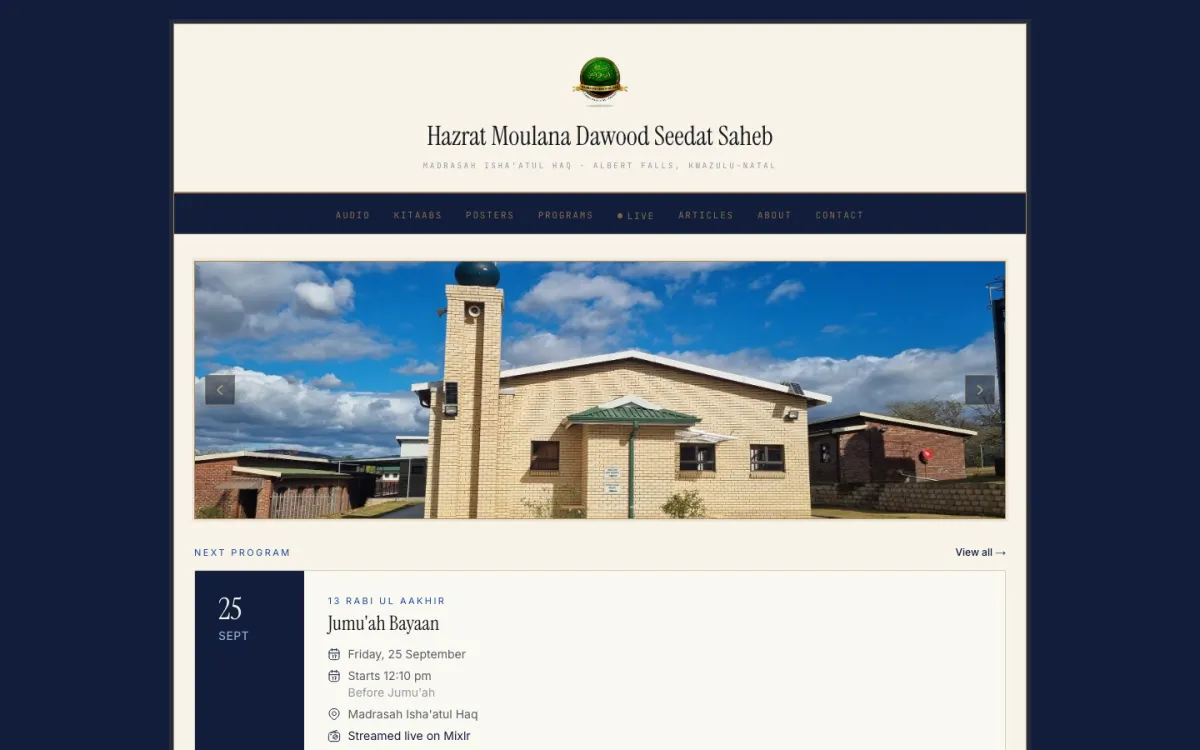
dawoodseedat.co.za
Moulana Dawood Seedat
Audio archive of lectures with a searchable index and live broadcasts.
Live site
Audio archive of Moulana Dawood Seedat's lectures, with a searchable index and live broadcasts.
Case study
Maktabapp
iOS and Android apps with a landing site. The full 13-Line Qur'an works offline, voice search finds a verse from recitation, and children learn from letter-by-letter audio lessons.
A normal week
Hardly anyone finds a madressa or a masjid programme through a search. A parent hears about it from family, a listener from a WhatsApp group. Then they open the website to check something specific: whether admissions are open, what time Jumu'ah is, where last week's talk went.
So the site is a reference people come back to every week. It fails when the information goes stale, and it goes stale when every change means waiting for the person who built it. Most of these organisations run on a small office and volunteers, and the tools have to suit them.
Recordings are the other big need. Years of talks sit on hard drives, streaming accounts and old sites nobody can log into. Put in one place with search, they become something a student can use.
02Problems we hear
What goes wrong
- Parents phone the office to ask whether admissions are open.
- Application forms get printed, filled in by hand and retyped by the secretary.
- Our notices go out on WhatsApp and have scrolled out of sight by Monday.
- Twenty years of bayaans are spread across hard drives and a website nobody can log into.
- Listeners can't find a talk unless they remember the date it was given.
- Each masjid posts its Jumu'ah time somewhere different, if it posts it at all.
- A volunteer built our website and has since moved on, taking the password with him.
03Build
What we'd set up
School and madressa websites
Programmes, salaah times and admissions with online applications, plus notices the office posts from the admin. Business sites start at R12 000 and the subscription is R1 500 a year.
Websites →Audio and lecture archives
Every recording in one place with a searchable index, and live audio when a programme is on. KYF's archive searches across a transcript of every talk; kah.org.za carries the kitaabs alongside the majaalis.
Websites →Shared community listings
One site that many organisations keep current, like Jumu'ah, where each masjid's rep updates the week's time and speaker. Custom systems start at R50 000.
Web apps & systems →Learning apps
iOS and Android apps from one Flutter codebase, built for daily use and for reading offline. Maktabapp is the example: a 13-Line Qur'an reader with audio lessons for children.
App development →Apps for running a non-profit
Makarim runs its soup kitchen from one app. Volunteers see who has eaten and how much food is left, and the kitchen's stock sits in the same records.
Web apps & systems →Libraries of text and translation
Collections people browse and search, like Translated Treasures, where each nasheed has its meaning translated line by line.
Websites →04AI
Tasks AI can take over
- Transcripts of recorded talks made by speech-to-text. Someone who knows the subject checks names and Arabic terms before a transcript is published.
- Admission applications checked for missing documents as they arrive. The office still decides who is accepted and replies to every parent.
- A reminder to a masjid rep or teacher when the week's details haven't been filled in. The person still writes the details themselves.
- Suggested titles and topics for untitled recordings, reviewed before they go live. Each workflow is R15 000 to R60 000.
05Steps
From first call to launch
Start with who updates it
On the 20-minute call we ask who will post notices, times or recordings each week, and shape the admin around that person. A fixed quote follows within two working days.
Gather what already exists
Recordings, forms, timetables and old site content get listed before design starts, so nothing is lost in the move.
Build on a private link
Working pages go up from week one. The secretary tries the admissions form, or a rep posts a test time, before the public sees anything.
Hand over and train
We show the people who will run it how to post and edit. After launch, questions get an answer by the next working day.
Questions
What people ask on the first call
If yours isn't here, WhatsApp it and you'll have an answer within one working day.
Yes. Notices, programmes and times are edited from an admin in the browser. On Jumu'ah, each masjid's rep updates their own entry every week.
Yes, in one archive with a searchable index, as on Moulana Dawood Seedat's site and KYF. The work depends mostly on how the files and their details are stored now, so we look at a sample before we quote.
For most schools and organisations a website is enough, and it opens on any phone without an install. An app earns its place when people use it daily or need it offline, as with reading the Qur'an in Maktabapp. Apps are custom work from R50 000, built once in Flutter for iOS and Android.
Yes. The files go to private storage that only staff with a login can open, instead of a shared email inbox. Application documents carry children's details, so they shouldn't sit in anyone's personal mail.
A Profile site starts at R5 000. A Business site, from R12 000, adds a page per programme, an enquiry inbox and a blog or notices page you can edit. The subscription is R1 500 a year and covers hosting, backups and the admin.
Children's information and POPIA
Admissions forms collect children's details, and POPIA sets extra conditions for processing a child's personal information, generally including consent from a parent or guardian. We ask only for what the office needs to decide, and keep uploaded documents where only staff who log in can see them. The school or organisation stays responsible for its own policies. This isn't legal advice.
Tell us what you need
Answer a few questions and the estimate shows on screen. The fixed quote follows within two working days of a short call.